
The originality of the ZEUS approach lies in its dual objective of reducing water consumption and enabling the reuse of effluents after treatment. It has demonstrated the efficiency of the advanced recycling process and of the separation of streams (water/salts/nutrients) in order to regenerate and reuse them in proportions above 75%. The innovation lies in combining these techniques under real-life conditions.
Following the study of the different streams and uses carried out in 2019 at the MONIN demonstration site in Bourges, 90% of treated industrial wastewater can be reused, provided that water suitable for food contact can be produced.
The two core technologies of the project
At industrial scale, two membrane filtration prototypes integrated into the process facilities of the MONIN site form the LIFE ZEUS demonstrator:
R-Oasys® for the treatment of organic streams, uses a microfiltration (MF) membrane (a proven material in a novel configuration), a low-pressure nanofiltration membrane for efficient treatment of sugary effluents, and a reverse osmosis finishing treatment. Low pressures and high permeability will deliver exceptional energy performance.
ReGeCycle® for the specific treatment of salt streams from water softeners, in order to reuse the concentrated brines as a substitute for salt, with in-situ recycling of 38 t of salt per year.
Background and origins of the project
A state-of-the-art study, conducted jointly by INSA, OiEau and MONIN, highlighted the benefits of membrane filtration in terms of performance, costs, and ease of implementation and operation.
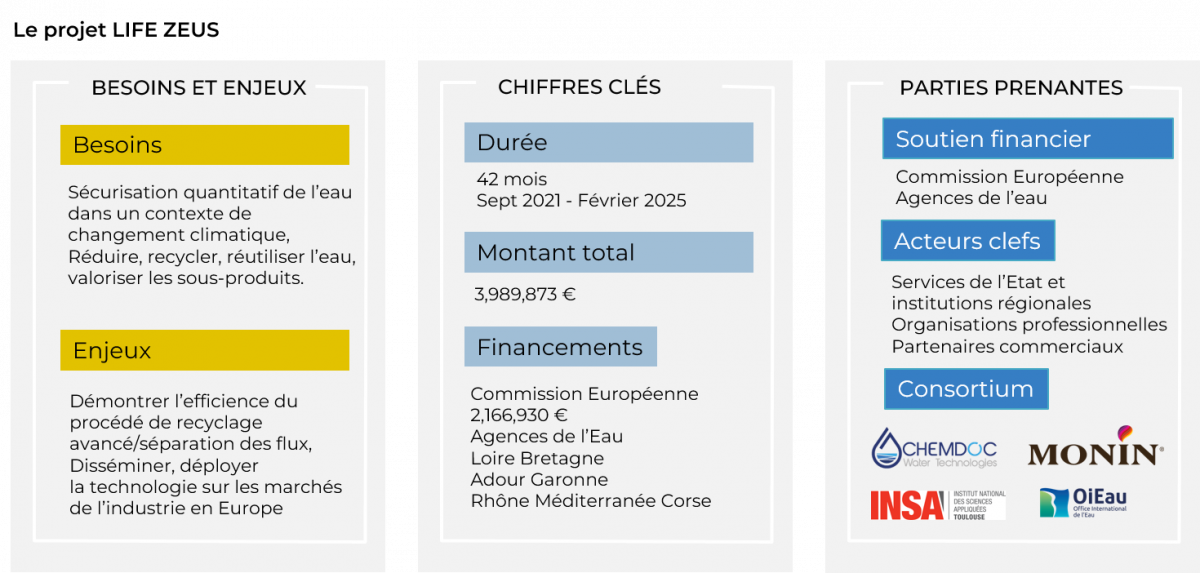
The membrane technologies offered by CHEMDOC WATER were identified, then complemented by a pilot trial. In July 2020, CHEMDOC proposed creating a consortium to submit a bid to the European Commission's LIFE programme.
Key figures
|
90%
of wastewater reusable at the MONIN site
|
|
> 75%
of streams regenerated and reused
|
|
2
industrial prototypes deployed
|
|
2019
Preliminary study at the MONIN site
|
|
|
General objectives
|
The general objectives of LIFE ZEUS fall within those defined in Article 3 of the LIFE Regulation (1293/2013). They aim for "a transition to a more resource-efficient economy, resilient to the effects of climate change" and to "improve the development, implementation and enforcement of EU environmental policy and legislation" by implementing an industrial wastewater reuse solution.
The solution deployed in the LIFE-ZEUS project provides a safe and efficient use of water resources, improving quantitative water management, preserving a high level of water quality and preventing the misuse and deterioration of water resources in the demanding context of the agri-food industries.
- The project has notably produced site visits, an enhanced e-book gathering the lessons learned from the project, participation in events to present the solutions developed, as well as training sessions.
- In a second phase, the project's After-LIFE will make the solutions developed sustainable and maintain the momentum for at least five years after the end of the project.
|
|
Initial project objectives
|
|
LIFE ZEUS aims for the reuse of effluents compliant with food-contact requirements. At the demonstration site, this will represent 45,000 m³ per year, i.e. 100% of the wastewater volumes will be treated and 40,500 m³ reused in situ, reducing water withdrawals by 68%. The 5-year After-LIFE objective aims at setting up 186 installations that will treat 1.5 million m³ of effluents, saving 1.3 million m³ of withdrawals. The project aims to contribute to changes in regulations on the best available techniques (BAT) for effluent treatment and recycling. |
Results achieved
45,000 m³
treated / year
− 68%
withdrawals
186
installations at 5 years (After-LIFE)
1.3 M m³
saved over 5 years
|
|
|
Circular economy objectives
|
|
The R-Oasys® technology will enable the recycling of 405 t of COD per year, i.e. 1,688% more than today, leading to the production of 1.5 million kilowatt-hours of renewable biogas. ReGeCyle® will enable the in-situ recycling of 38 t of salts contained in 372 m³ of brine per year, i.e. 76% and 82% of current consumption respectively. In total, over 5 years, 14,985 t of COD and nearly 25,000 t of brines containing 2,689 t of NaCl will be recycled or recovered thanks to the setting up of 186 new installations. |
Key figures
405 t
COD recycled / year (+1,688%)
1.5 M kWh
renewable biogas
38 t
salts recycled / year (82%)
14,985 t
COD recovered over 5 years
|
|
|
Climate neutrality objectives
|
|
By avoiding the discharge of 38 t of salt per year into the aquatic environment through the recycling of 82% of the MONIN site's brines, the project will make it possible to recycle 40,500 m³ of water and recover 405 t of COD per year, i.e. 90% of discharges and 100% of COD. By producing 1,501,100 kWh of renewable gas, the project avoids annual emissions of 1,419 t of CO₂ (−3,952%) per year for the water sector as a whole, i.e. more than 33,000 t over 5 years. These objectives aim to meet the goals of Regulation (EU) 2021/1119 and the EU Biodiversity Strategy for 2030. |
Key figures
− 1,419 t
CO₂ avoided / year (−3,952%)
+ 33,000 t
CO₂ avoided over 5 years
100%
COD recovered as energy
1,501,100
kWh renewable gas / year
|