

LIFE ZEUS project monitoring
The monitoring set up as part of LIFE ZEUS makes it possible to secure the operation of the demonstrator and the quality of the reused water, while tracking the performance of the installations.
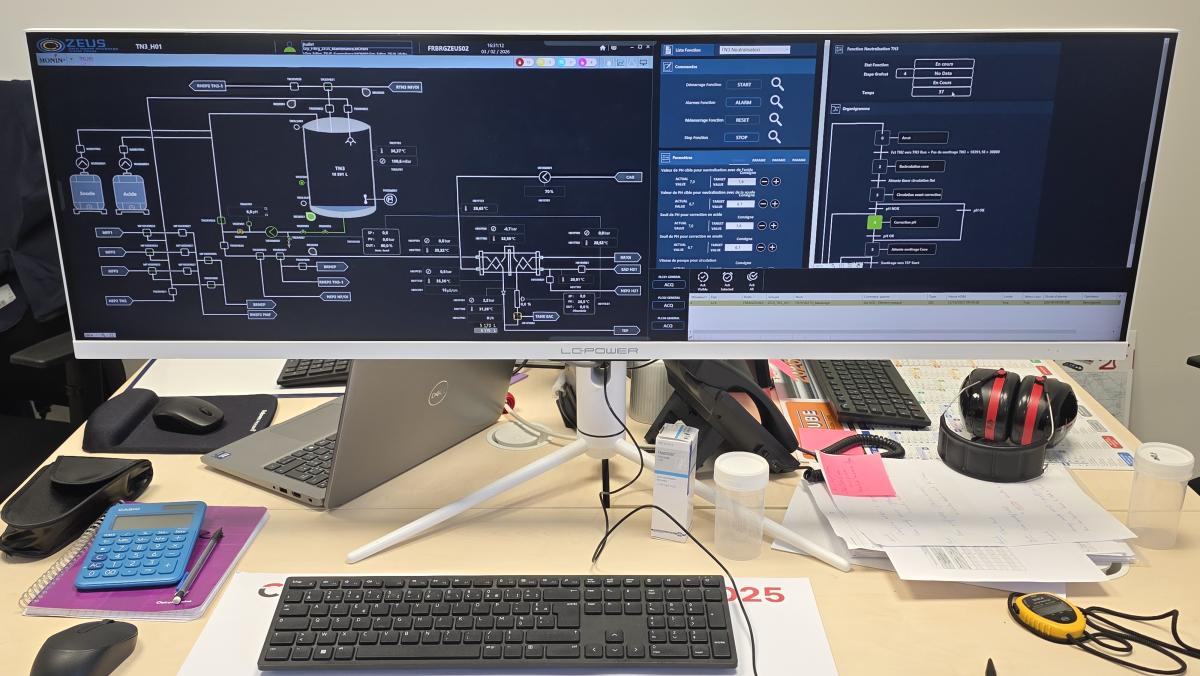
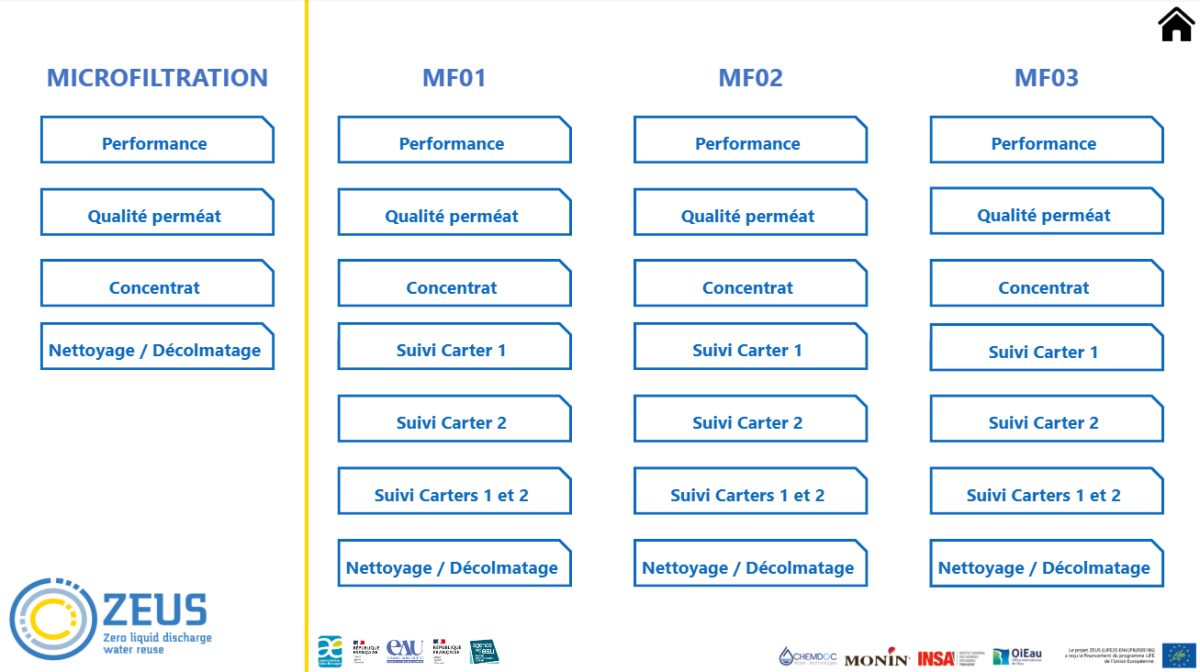
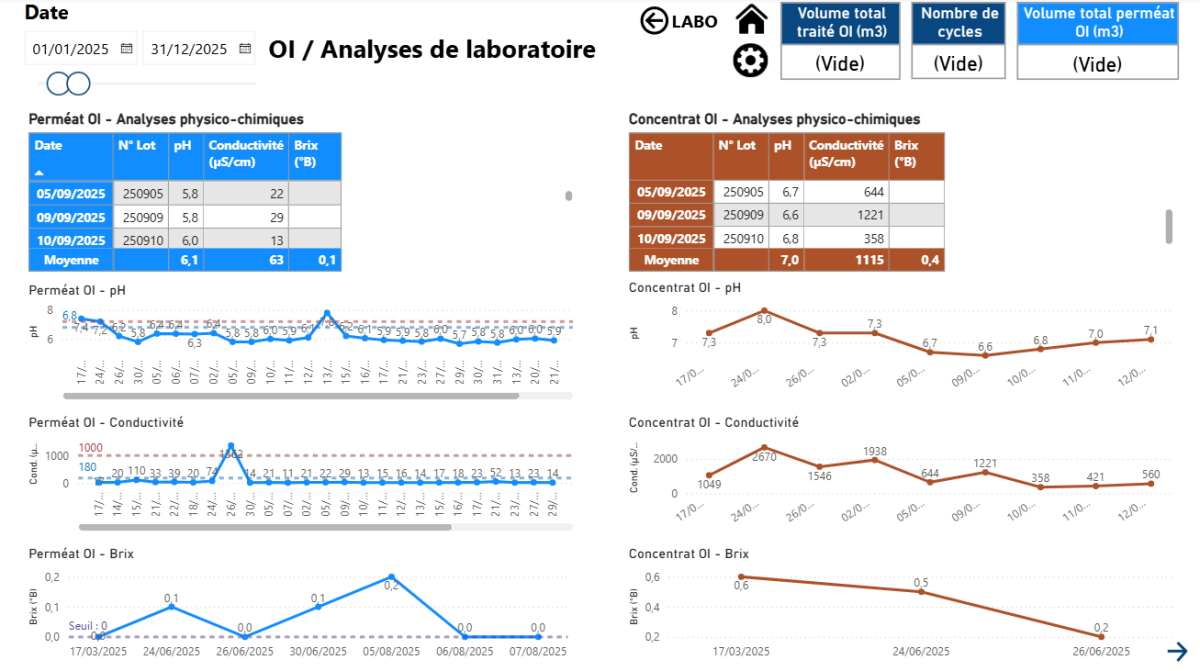
Sensors continuously monitor key parameters such as flow rates, pressure, conductivity, turbidity and temperature. The data is centralised in a supervision system that makes it possible to view performance, keep a history and quickly detect any drift. Complementary analyses make it possible to check water quality at the different stages of the process and to secure its use.
Monitoring at every stage
|
Water resource
Monitoring of the quality and characteristics of the water entering the system. |
|
Membrane treatment
Control of equipment operation and treatment performance. |
|
Storage before reuse
Monitoring of the quality of the water produced before it is used. |
Distribution and reuse
Control of quality and distribution conditions up to the points of use. |
Training and ownership by the teams
The success of a REUSE project does not rely solely on the equipment. LIFE ZEUS also made it possible to train the teams in operating the new installations, monitoring water quality and the critical monitoring points.
This ownership by the operators is one of the essential conditions for guaranteeing, over the long term, food safety, the reliability of the installations and control of performance.
DATA COLLECTION, SUPERVISION AND REPORTING
Data from the equipment and sensors is fed into a supervision system that enables:
- Continuous monitoring of the main parameters;
- Data archiving;
- Detection of drift and triggering of alerts;
- Monitoring of the volumes of water treated and reused;
- Monitoring of energy consumption and equipment performance.
This data is both a day-to-day operating tool and a basis for evaluating the project's performance.
FROM DEMONSTRATION TO REPLICATION
LIFE ZEUS is not limited to the demonstrator installed at the MONIN site in Bourges. The project was designed to produce lessons, methods and solutions that can be transferred to other agri-food sites.
The replication approach is based on three principles:
Adapt rather than reproduce identically
Each site has its own streams, uses, health constraints and water needs. The solution must therefore be sized on the basis of a precise water diagnosis.
Match technical solutions to the right use
The level of treatment is defined according to the quality of the water available and that required at the point of use.
Build in operation and monitoring from the start
Monitoring, maintenance, team training and regulatory control are an integral part of the REUSE project.
SOLUTIONS TRANSFERABLE TO OTHER AGRI-FOOD INDUSTRIES
The lessons from LIFE ZEUS can be applied in different agri-food sectors with high water consumption and stringent health requirements.
However, membrane technologies, disinfection systems, stream separation and reuse principles must be adapted to the characteristics of each site and each effluent. The modularity of the approach makes it possible to consider different levels of reuse, from a loop targeted at a single use to a more comprehensive approach to reducing withdrawals and discharges.
KEY LESSONS FROM THE PROJECT
|
-25%
water consumption
Optimisation of processes and reuse loops |
|
-70%
liquid discharge
Internal reuse and stream separation
|
38 t/year
of NaCl recovered
Regeneration and reuse of water softener brines
|
|
405 t/year
of co-products recovered
Recovery of organic concentrates
|
|
3 to 5 years
return on investment
Depending on the initial concentration and the site configuration
|
And after LIFE ZEUS?
The aim is now to build on the results and lessons of the demonstrator to facilitate the development of new water reuse projects.
The LIFE ZEUS Enhanced E-book identifies a potential for more than 186 replications within five years, at other sites and in other agri-food sectors.
Beyond the number of installations, the challenge is to spread an approach: know your streams, reduce consumption at source, identify reuse opportunities, match water quality to uses and ensure reliable monitoring over the long term.